Scribeberry
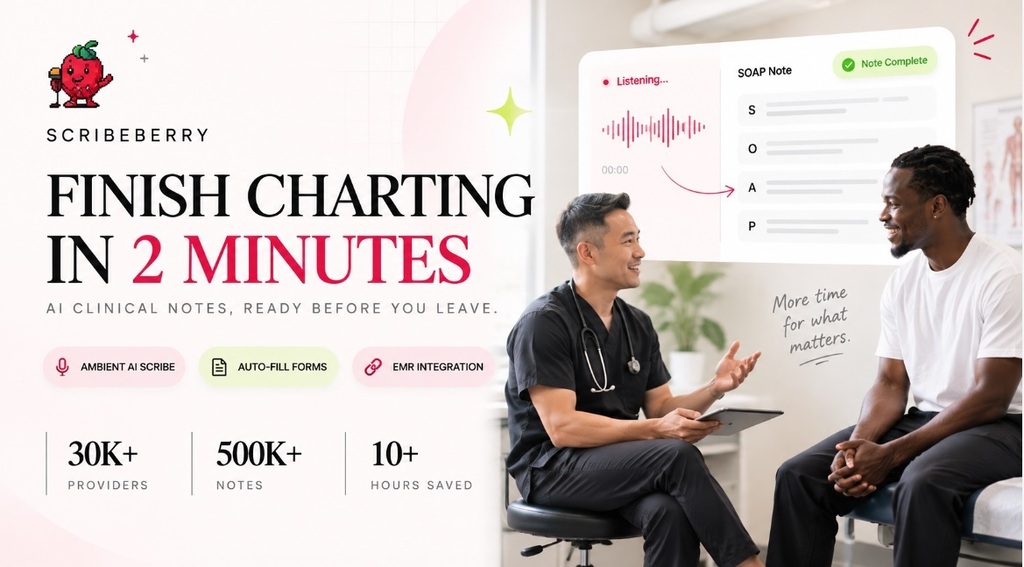
An ambient AI scribe that turns clinical conversations into structured, EMR-ready notes so doctors can look at patients instead of screens.
The problem
Charting was eating the visit.
Doctors were spending two hours typing notes for every hour spent with patients, and most of it happened after hours, at a keyboard, away from the person they'd just seen. Existing dictation tools produced transcripts, not notes. Existing templates required manual assembly. Nothing understood the shape of a clinical encounter well enough to write the chart itself.
The ask was not "transcribe the visit." It was "let the doctor leave the room with the note already done, in the format their EMR expects, without asking them to trust a black box with patient data."
What I built
One conversation, many finished outputs.
Scribeberry listens to a visit (in person or via telehealth), separates speaker turns, and reasons over the transcript to produce a structured note, not a wall of text. A doctor picks a template, SOAP, consult, referral, intake, and the system fills it the way they would, using their own prior notes as style reference where available.
A parallel forms pipeline reads referral letters, insurance forms, and government paperwork, and pre-fills them from the same encounter data, so a form that used to take fifteen minutes of re-typing takes one click of review.
- 2000+ clinical templates
- 40+ language support
- One-click EMR handoff
- Specialty-tuned note generation
- Human-in-the-loop review before anything is saved
System design
Separate listening from writing.
The ambient layer only produces a redacted, speaker-labeled transcript. A second, template-aware stage turns that transcript into a note, choosing section headers, clinical language, and level of detail based on the selected template and specialty, never inventing content the transcript doesn't support.
Everything the model drafts lands in an editable note the clinician reviews before it touches the EMR. Nothing writes to a patient record without a human confirming it first.
The model drafts the chart. The clinician still signs it.
Privacy and reliability
Built for a room where consent matters.
Audio and transcripts are encrypted in transit and at rest, regional by default (Canadian data stays in Canada, US data in the US), and never used to train models. Clinicians can delete encrypted copies at any time, and own every note they generate outright.
The system is designed to degrade safely: if a template can't be confidently filled, it surfaces the gap for the clinician to complete rather than guessing, and every EMR push requires an explicit, logged confirmation.
HIPAA & PIPEDA compliant SOC 2 Type II Encrypted at rest and in transit No model training on patient data Human confirmation before every EMR write
Built with
- AI/LLM Development
- Speech-to-Text/Audio AI
- Python
- Backend Development
- React
- TypeScript
- NLP & Medical Document Processing
- EHR/EMR API Integration
- Cloud Engineering — Azure & GCP
- Healthcare Security — HIPAA / PIPEDA / SOC 2