CliniQuill
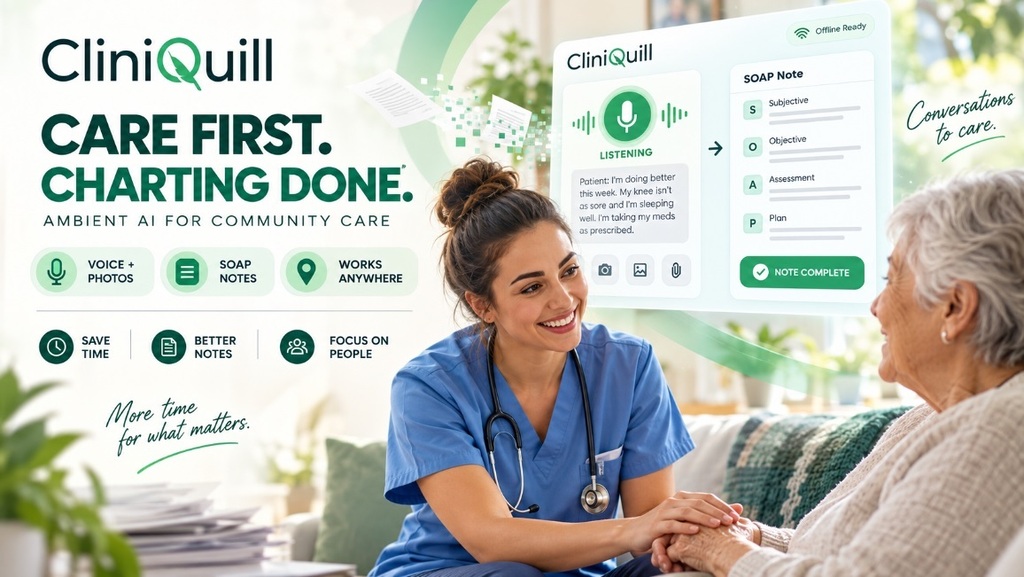
An offline-capable ambient AI scribe built for community and home-care nurses who chart from a car, a client's kitchen table, or a reserve with no signal.
The problem
Most ambient scribes assume a clinic: steady Wi-Fi, one patient at a time, a desk to type at afterward.
Community nursing looks nothing like that. A visit might happen in a car, a client's home, or a rural community with no cell coverage at all, and the same nurse could see fifteen clients in a day, each needing a different kind of note: a wound photo, a safety assessment, a progress update against a case that's been open for months.
The ask was a scribe that worked exactly where the care happened, not just where the internet did, and that could reason over voice, photos, and documents together instead of transcript text alone.
What I built
Charting that keeps up with a moving day.
CliniQuill captures a visit through voice, photos, or scanned documents, entirely on-device when there's no connection, and queues everything to sync the moment a signal returns. A nurse can dictate a wound note between houses, and the app timestamps and files it against the right client and the right point in an ongoing case, so progression over weeks becomes visible instead of buried across separate entries.
Photos attach directly into reports, so a home safety assessment ships with evidence, not just prose, and a referral response can show a client's context instead of describing it.
- Fully offline capture and drafting
- Voice, photo, and document input in one note
- Longitudinal case and disease-progression tracking
- Non-linear, multi-stop mobile workflows
- Zoom, Teams, and Meet support for virtual visits
System design
Local-first, sync-second.
Every note starts as a local draft: audio, images, and any scanned paperwork are processed on-device so a dead zone never blocks documentation. Once the device reconnects, drafts sync, resolve against the client's existing case timeline, and become available across the care team, without requiring the nurse to re-open anything.
Because visits rarely happen in a fixed order, the app doesn't assume a linear session. A nurse can pause a note, drive to the next client, and return to the first draft hours later exactly where they left it.
The chart shouldn't need a signal. The nurse already doesn't have one.
Trust and community fit
Built with the communities it serves, not just for them.
CliniQuill was developed with home-care nurses, occupational therapists, and community paramedics in the room, including nursing teams in First Nations communities, so that workflows, terminology, and consent conversations fit real practice rather than a clinic template. Every note stays attributable to the clinician who made it, and clients are told plainly, during the visit, that an AI is assisting.
ISO-certified data handling On-device processing where connectivity doesn't exist Built and validated with home-care and allied health clinicians Indigenous community trust and benefit as a design constraint, not an afterthought
Built with
- AI/LLM Development
- Speech-to-Text / Voice AI
- Python
- Backend Development
- React
- Mobile App Development
- NLP & Clinical Document Processing
- Computer Vision / Image Processing
- Offline-First Data Sync & Cloud Engineering
- Healthcare Security & Privacy Compliance