Clinked
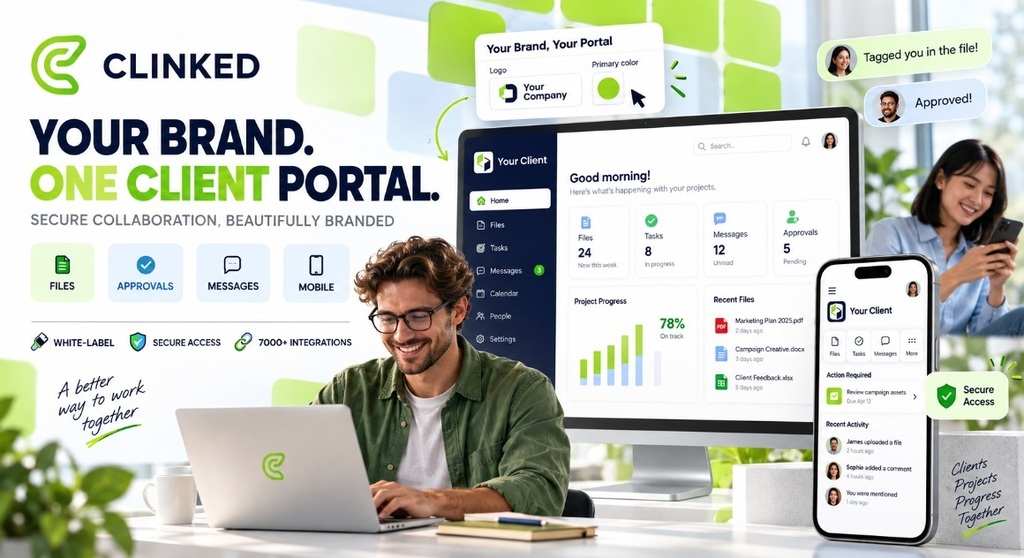
A white-label client portal that gives agencies, accountants, and advisory firms a single branded workspace for files, approvals, and client communication — instead of a scattered mess of email threads and shared drive links.
The problem
Client work was happening in five different inboxes.
A mid-sized advisory firm was running client collaboration the way most service businesses do: contracts over email, files in a shared drive nobody could find things in, status updates buried in reply-all threads, and approvals tracked in a spreadsheet someone had to update by hand. Every client saw a different, ad hoc version of "working with us," and every project manager was quietly running their own system.
The firm didn't need another generic file-sharing tool. They needed one branded, structured place where a client could log in, see exactly where things stood, upload or approve what was needed, and never have to ask "did you get my email?" again.
What I built
A branded workspace that replaces the inbox.
Portway gives each client a dedicated, white-labeled workspace — same domain, same logo, same color system as the firm's own brand — for files, tasks, approvals, and messaging. I built the system end to end: the multi-tenant workspace architecture, the white-label theming engine, the file and approval pipeline, and the admin dashboard firms use to spin up and manage client spaces.
Every workspace is provisioned from a single template but themed independently, so a firm managing forty clients can give each one a workspace that looks like it was built just for them, without forty separate deployments. Files are versioned automatically, approvals are tracked with a clear audit trail, and clients get a single activity feed instead of a pile of notification emails.
- Multi-tenant workspace provisioning (isolated data, shared infrastructure)
- White-label theming engine (logo, domain, color tokens, email sender identity)
- File management with versioning and approval workflows
- Real-time activity feed and in-app messaging
- Admin dashboard for firms to manage clients, permissions, and branding
By the numbers
- 40+
- Branded client workspaces from one codebase
- 70%
- Fewer status-update emails
- Sub-2-second
- Workspace theme switching
- Days → under an hour
- Onboarding time
Illustrative figures.
System design
One codebase, infinite brands.
The core design decision was to separate identity from infrastructure. Every workspace runs on the same backend and shares the same underlying data model, but branding — logo, palette, custom domain, even the sender address on notification emails — is resolved at request time from a per-tenant config, not baked into a build. That meant onboarding a new client firm was a configuration step, not a deployment.
Permissions were modeled around the reality of client work: a firm's staff need full visibility across their book of clients, while each client should only ever see their own workspace, with no way to accidentally glimpse another client's files. Role-based access control enforced that boundary at the API layer, not just in the UI.
The client shouldn't have to think about the tool at all. If they notice the portal, something went wrong.
Reliability and rollout
Built to disappear into the client relationship.
Because this was the client-facing surface of the firm's brand, uptime and load time mattered as much as features — a slow or broken portal reflects on the firm, not on Portway. Static assets and themed CSS were served through a CDN, file uploads went straight to object storage rather than through the app server, and the theming layer was cached aggressively so switching between branded workspaces stayed fast even as the number of tenants grew.
Rolling out from ad hoc email-and-spreadsheet coordination to a single branded portal changed how the firm's teams worked day to day: project managers stopped chasing status in their inboxes, and client conversations moved from "let me check and get back to you" to a shared, always-current view both sides could see.
Built with
- Full-Stack Web Development
- React
- JavaScript
- TypeScript
- Backend & REST API Development
- SQL
- Database Engineering
- Cloud Storage & File Management
- Real-Time Chat & Notifications
- Authentication, SSO & Role-Based Permissions
- Cloud Security & DevOps