Accord
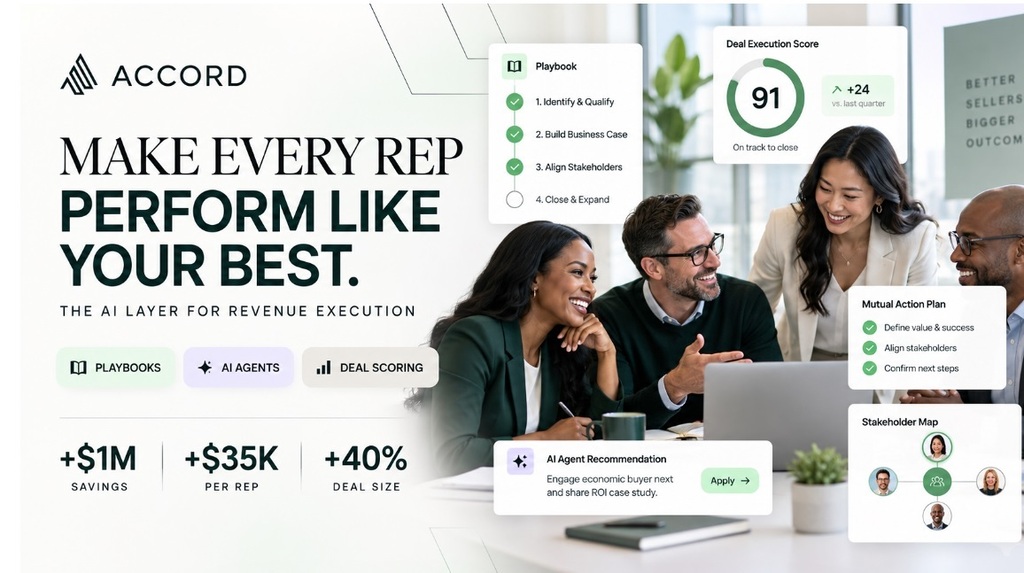
An AI layer for revenue teams that listens across a sales org's tools and turns scattered signals — a call transcript, an email thread, a stalled deal — into the specific follow-up action a rep would otherwise have to notice, remember, and do themselves.
The problem
The signal was already there. Nobody had time to act on it.
A revenue team had all the data a great rep would use to work a deal well — call transcripts, email threads, product usage signals, calendar activity — spread across half a dozen disconnected tools. A top performer might piece it together and remember to loop in a second stakeholder or follow up before a deal went quiet. Everyone else was too busy running their next call to notice a deal had stalled until it showed up as a loss in the pipeline review.
The team didn't need more dashboards to check. They needed the work between calls — the follow-ups, the re-engagement nudges, the "this deal just went quiet" catch — to happen automatically, at the standard of their best rep, for every rep.
What I built
Agents that do the work reps don't have time for.
Accord ingests activity across a team's GTM stack — call transcripts, email, CRM activity, calendar — and runs it through a set of AI agents that each own a specific job: drafting a follow-up after a call, flagging a stakeholder who's gone quiet, assembling a mutual action plan from a call's commitments. I built the system end to end: the signal-ingestion pipeline, the agent orchestration layer, the human-review queue, and the rep-facing action feed.
No agent action goes out unreviewed by default. Each suggested follow-up, flag, or drafted email is generated with the specific transcript excerpt or activity it was triggered by attached, so a rep can approve it in seconds rather than verifying it from scratch.
- Multi-source signal ingestion (calls, email, CRM, calendar) via a shared event pipeline
- Agent orchestration layer, one agent per job (follow-up drafting, stall detection, action-plan assembly)
- Human-in-the-loop review queue before any agent action is sent
- Rep-facing action feed, ranked by deal priority
- Full audit trail linking every agent action back to its source signal
By the numbers
- ~5 hrs/week
- Returned to each rep
- 3x
- Faster follow-up after calls
- 90%+
- Agent-drafted actions approved without edits
- 9 days
- Earlier median detection of stalled deals
Illustrative figures.
System design
An agent is only as good as its leash.
The core design decision was that agents should draft and flag, not act autonomously on a customer-facing deal. Every agent's output was scoped narrowly — one job, one type of action — and routed through a review queue before anything reached a prospect or customer. That kept the system trustworthy in a context where a wrong or oddly-toned email sent on a rep's behalf could cost a deal, not just annoy someone.
The ingestion pipeline was built around a shared event model so a new signal source (a new call-recording tool, a new CRM) could be added without touching the agents downstream. Each agent consumed the same normalized event stream and only cared about the events relevant to its job, which kept adding new agents cheap rather than a rewrite each time.
An agent that's always right but never explains itself gets ignored the first time it's wrong. Show the source, every time.
Reliability and rollout
Built so a bad suggestion costs seconds, not trust.
Because agent output touched real customer relationships, every suggested action carried a confidence signal and its source excerpt, and low-confidence flags were routed to a human before ever reaching a rep's action feed as a recommendation. Ingestion was built on a durable event stream so a downed integration didn't lose signals, only delayed them, and every agent action was logged against the exact event and model version that produced it for later review.
Rolling out from manual, best-effort follow-up to an agent-assisted action feed changed the shape of a rep's day: the after-call admin work that used to get skipped when the day got busy started happening consistently, and managers could see, for the first time, which stalled deals had actually been caught early versus quietly lost.
Built with
- AI Agent Development
- LLM Development
- React
- Next.js
- TypeScript
- Node.js
- Backend Development
- PostgreSQL
- Database Engineering
- CRM API Integration
- Salesforce
- HubSpot
- Workflow Automation
- RAG
- AI Knowledge & Context Systems
- MCP & Third-Party API Development