ChartGuard
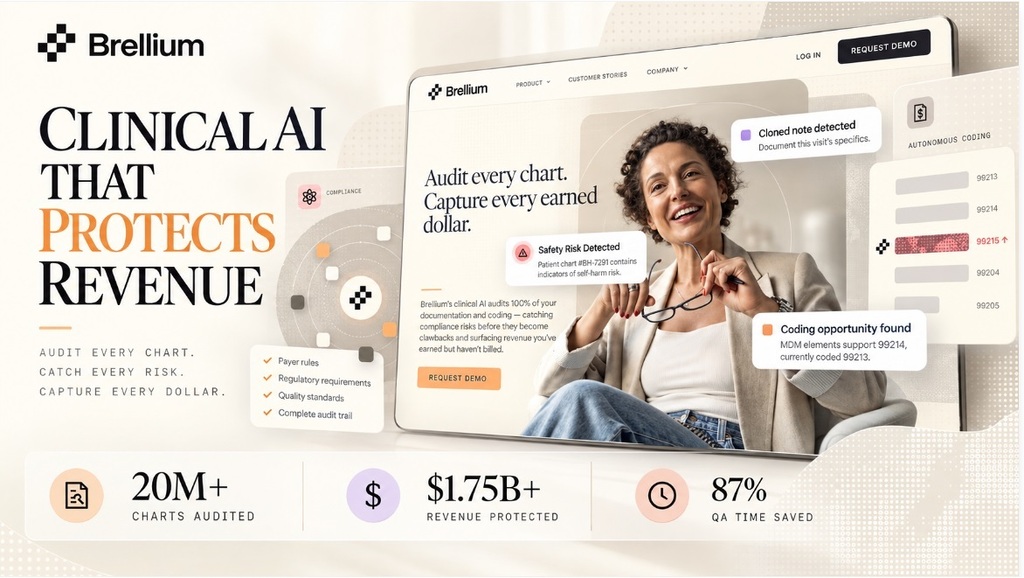
A clinical AI platform that audits every documented visit before it bills, catching compliance risks and under-coded revenue that manual sampling misses.
The problem
Behavioral health providers could only ever spot-check a fraction of their charts.
A multi-site behavioral health organization was reviewing about 5% of clinical notes for compliance and coding accuracy, simply because a human reviewer could not read every chart before it billed. That left the other 95% unexamined: missed documentation gaps that could trigger a payor clawback, undercoded visits that quietly left revenue on the table, and safety-relevant details buried in notes that no one had time to catch in real time.
The organization didn't need a better sampling method. They needed every chart reviewed, not just a defensible fraction of them, without hiring an army of reviewers to do it.
What I built
A pipeline that reads every note before it bills.
ChartGuard reviews clinical documentation against payor policy, regulatory requirements, and the organization's own quality standards, then flags issues and suggests coding corrections before a claim goes out. I built the system end to end: the note-ingestion pipeline, the compliance rules engine, the autonomous coding module, and the clinician and compliance-officer dashboards.
Each note is parsed and checked against the applicable payor's rules, matched against the visit's documented elements to verify the billed code is supported, and screened for safety-relevant patterns like missed-session runs or risk indicators. Flags come with a specific resolution step, not just a red X, and every code suggestion is backed by the exact documentation that supports it.
- Clinical note ingestion and structuring pipeline
- Payor/regulatory rules engine, updated per state and program
- Autonomous coding module (under- and over-coding detection)
- Safety-pattern detection (self-harm indicators, missed-session trends)
- Compliance officer dashboard with program-level quality scorecards
By the numbers
- 100%
- Of charts reviewed, not a sample
- 87%
- Less time spent on chart review
- 99%+
- Documentation compliance achieved
- 20 hrs → a few
- Review time per cycle
Illustrative figures.
System design
Flag with a citation, code with an audit trail.
The core design decision was that nothing gets flagged or coded without a traceable reason. A rules engine encodes payor and regulatory requirements per state and program, so a flag always points to the specific standard it failed. The coding module compares the documented medical decision-making and elements against the billed code and only surfaces a discrepancy when the documentation itself supports a different code, with the relevant sentence attached.
This made the system usable in an audit context, where a black-box flag is worse than no flag at all. Compliance officers could see exactly which requirement wasn't met and why, correct it before billing, and use the same record if a payor ever audited the claim later.
The model finds the gap. The clinician still closes it.
Reliability and rollout
Built for an industry where a missed flag has real consequences.
Because a missed safety indicator or a wrongly coded claim carries real risk, not just inefficiency, I treated recall on high-stakes flags (safety risk, medication discrepancies) as a separate, stricter threshold from routine documentation checks: those went to a human immediately rather than waiting in a queue. Every review, flag, and code suggestion was logged with the note version and rule version it was checked against, so the record stayed reconstructable for a payor audit months later. Role-based access and encryption at rest and in transit kept the system aligned with HIPAA requirements from day one rather than bolted on afterward.
Rolling out from a 5%-sample process to 100% review changed how compliance teams worked day to day: quality management moved from reactive spot checks after a clawback to proactive review before a single claim went out.
Built with
- Python
- Backend Development
- AI/LLM Development
- NLP & Clinical Document Processing
- React
- Next.js
- API & EHR/EMR Integration
- PostgreSQL
- Database Engineering
- AWS/Cloud Engineering
- Healthcare Security & HIPAA Compliance