Yuna
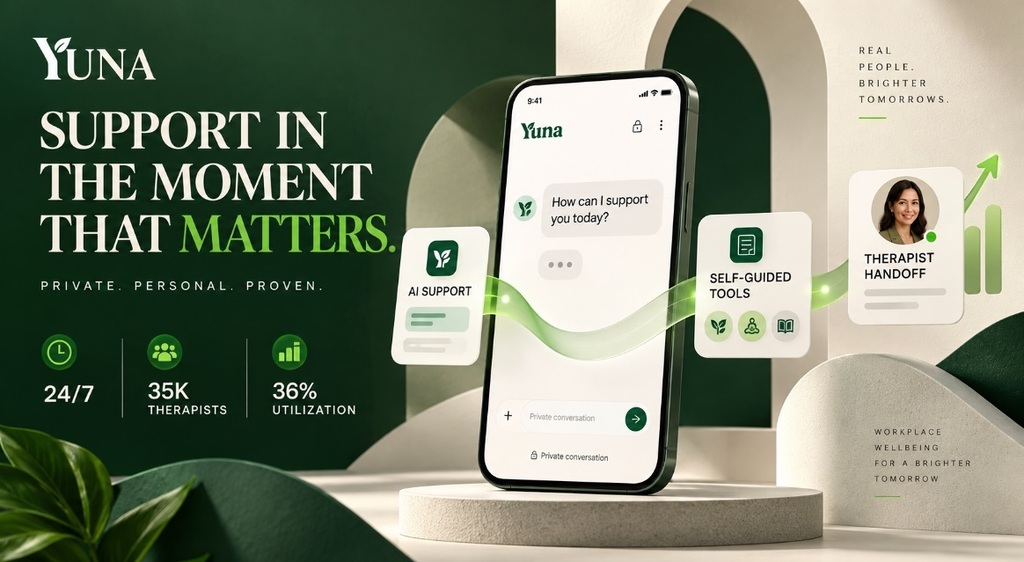
An always-on mental health coaching app for employers, built to meet people the moment they reach for it — and to hand off cleanly to a licensed therapist or crisis line the moment a conversation needs more than coaching can safely give.
The problem
Support that only exists 9-to-5 doesn't help at 11pm on a Tuesday.
An employer's mental health benefit was a traditional EAP: a phone number, a handful of free sessions, a waitlist to actually get matched with a therapist. Utilization was low, not because employees didn't need support, but because the benefit was only reachable during business hours, required scheduling a session in advance, and didn't fit the moment stress actually shows up — mid-shift, on a drive home, at 2am.
The company didn't need another underused line item in the benefits package. They needed something employees would actually open when they needed it, that could support them in the moment and knew exactly when to step aside for a licensed human.
What I built
A coach that's always reachable, and knows its own limits.
Yuna gives employees an AI coaching companion available by voice or text any time, alongside a network of licensed therapists it can book directly into. I built the system end to end: the real-time conversation engine, the escalation and safety-routing logic, the therapist-matching and booking flow, and the anonymized employer-facing engagement dashboard.
Every conversation is private by default — employers see aggregate trends, never transcripts or individual activity. The coaching layer handles day-to-day stress, mood, and habit support, and is built to recognize the specific signals that mean a conversation needs more than coaching: escalating distress, a mention of self-harm, anything at or near a crisis threshold. When that happens, the system doesn't try to handle it — it interrupts the flow and routes immediately to crisis resources and a licensed therapist.
- Real-time voice/text coaching engine with session memory across check-ins
- Safety classifier that routes crisis-adjacent conversations to human resources immediately, not into a queue
- Therapist network with in-app matching and booking
- Benefit routing (surfacing an employer's existing EAP, financial coaching, etc. at the right moment)
- Anonymized, aggregate-only employer dashboard — no individual transcripts ever exposed
By the numbers
- 36%
- Average utilization across employer accounts
- ~70%
- Sessions happening outside business hours
- 100%
- Flagged crisis-adjacent conversations routed within the same session
- Under 3 minutes
- Median time to book a matched therapist
Illustrative figures.
System design
The hardest engineering problem was knowing when to stop being an AI.
The core design decision was that the coaching model should never be the last line of defense. A separate, more conservative safety layer ran alongside every conversation, purpose-built to catch signals of crisis or self-harm risk — and when it fired, the response wasn't a scripted AI reply, it was an immediate, unambiguous handoff: crisis resources surfaced, a human path offered, the coaching conversation set aside. That threshold was deliberately set to over-trigger rather than under-trigger; a false positive costs a slightly awkward pause, a missed one doesn't.
Privacy was treated as core architecture, not a policy add-on. Individual conversations were encrypted and never surfaced to the employer in any form; what fed the employer dashboard was aggregated and de-identified at the data layer itself, before it was ever queryable — not filtered at the point of display.
The product's job on a hard night is to know it isn't the right tool for that night, and to get out of the way fast.
Reliability and rollout
Built for a product where a slow or wrong response isn't just a bad UX.
Because this ran in a context where getting it wrong mattered more than almost any typical consumer app, the escalation path was tested and monitored independently of general product uptime — its own alerting, its own on-call response, its own review process for every crisis-adjacent routing decision. Voice and text sessions were built to degrade gracefully: a dropped connection mid-session preserved context so a person didn't have to re-explain themselves if they reconnected.
Rolling out from a traditional, underused EAP to Tandem changed the shape of the benefit itself: support stopped being something an employee had to plan ahead to use, and the cases that genuinely needed a licensed therapist or crisis line were reaching one faster and more reliably than the old phone-and-waitlist model ever managed.
Built with
- AI/LLM Development
- Conversational AI
- AI Agents
- Voice AI
- Speech-to-Text
- Python
- Backend Development
- React
- React Native
- Mobile Development
- LLM Memory
- Personalization Systems
- iOS Health & Calendar API Integration
- Healthcare Data Security & Privacy